Module 1: Camera
Welcome to the world of photography! This foundational module is part of the Diploma of Photography and Digital Imaging (CUA50925) at PI, an internationally accredited program aligned with the Australian Qualifications Framework (AQF) Level 5 and regulated by the Australian Skills Quality Authority (ASQA). As a Diploma student, you will gain not only professional recognition but also access to exclusive resources and personalised guidance from highly specialised tutors.
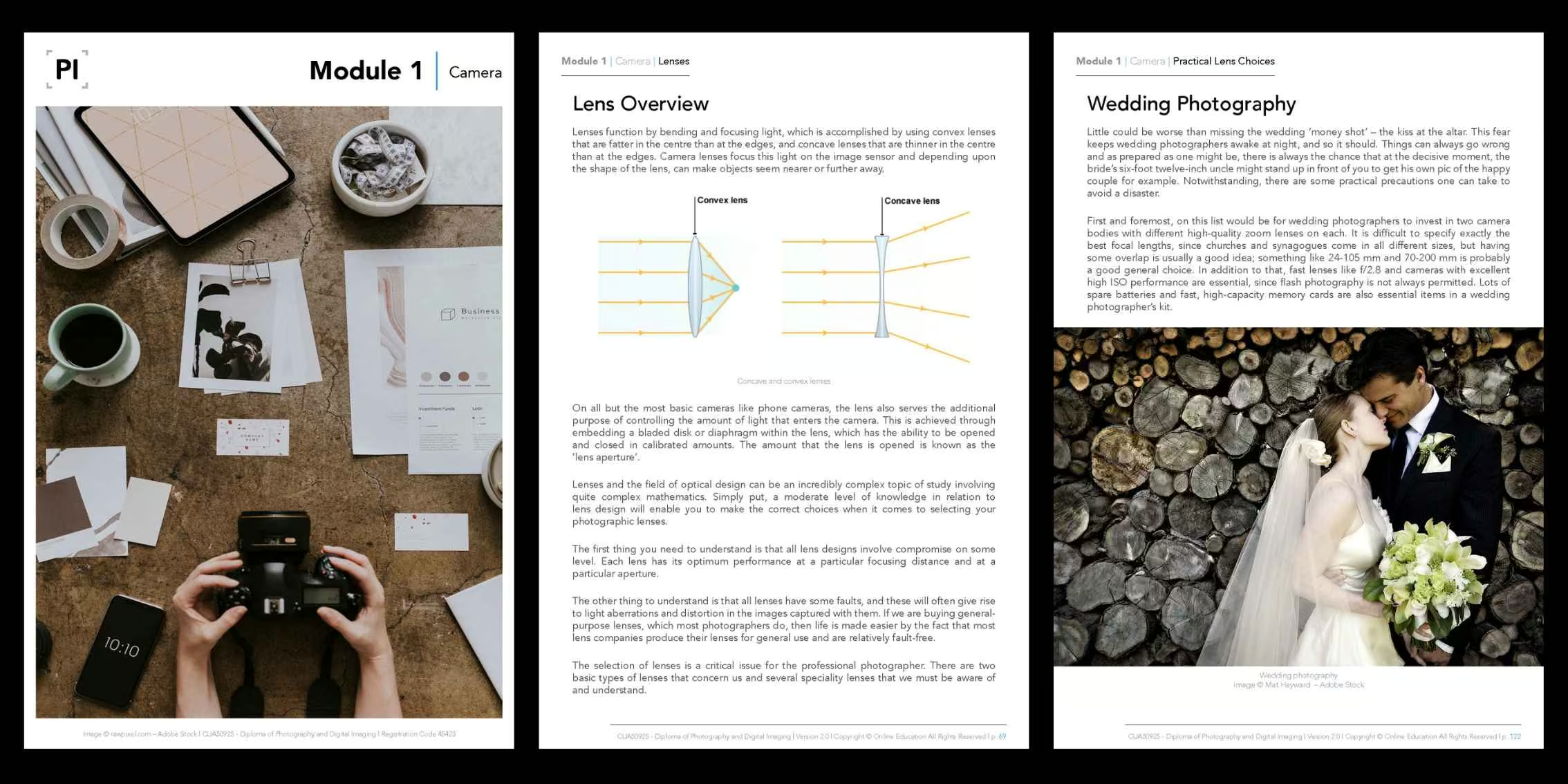
Module 1 is designed to help you understand how photography began, the various camera formats, lenses, and related equipment mechanisms and tools. You will explore the elements and principles of photography in a structured and analytical way. Understanding how your camera, as well as any other model, works will allow you to express your vision with confidence as you advance in our course. This module lays the groundwork for you to create sophisticated images that inspire and meet both client needs and industry standards.
Our course offers a range of resources and structured content created by qualified professionals who are active in the industry. Creativity, technique, and familiarity with industry requirements are essential elements. However, first, we'll focus on equipment, specifically cameras, lenses, and related settings and features. You’ll gradually start to understand the rationale behind creating thrilling images and begin to articulate your workflow in a professional context.
Why This Module Matters
Every accomplished photographer begins with a solid foundation. Module 1 will guide you through the early days of photography, including how cameras function, the various lens types available, practical lens choices, essential camera tools, and all the available course resources. By integrating theory with practical exercises and real-world examples, you will begin to develop the professional skills and critical thinking necessary for a successful photography career.
- Examine camera formats, lens options and make conscious decisions to achieve the look you intend.
- Analyse settings and control your equipment effectively and direct your creative inspiration.
- Combine theoretical concepts with practical experiments and start expressing yourself through your camera with a professional approach.
As part of the Diploma, this module is just the beginning of a comprehensive 12-module program, featuring assignments, quizzes, portfolio development, and exclusive content designed to equip you with the knowledge, skills, and professional confidence to excel in the photography industry.
What You’ll Learn
-
Course Structure, Authors & Resources
Get to know the authors and familiarise yourself with the course resources.
-
Equipment Essentials
Analyse camera formats and lens options to understand their attributes and use.
-
Camera Mechanisms & Tools
Learn how cameras function, essential operation tools, and recent innovations.
-
Practical Lens Choice
Understand which lens suits which genres, recommendations and limitations.

What You’ll Do
-
Examine & Depict Your Equipment
List your equipment and maintenance process, and capture a flat lay image of it.
-
Post-production Set Up
Capture an image and describe your editing suite following specific guidelines.
-
Camera Settings
Provide evidence of your camera settings, ensuring key items are included.
-
Lens Experiments
Analyse focal length, test, examine results and describe your findings.
Units Covered
This module integrates practical skills from the following accredited units:
- CUAACD522 – Work with photomedia in creative practice
- CUADIG415 – Produce innovative digital images
- CUAPHI312 – Capture photographic images
- CUAPHI403 – Enhance, manipulate and output photo images
- CUAPHI521 – Make illustrative photo images for publication and display
- CUAPHI531 – Apply visual communication theory to photo imaging practice
- CUAPHI535 – Produce commercial photo images
- CUAPHI536 – Provide photographic portrait services
- CUAPHI537 – Produce media photo images
- CUAPPR511 – Realise a body of creative work
These units are taught through practical tasks, interactive tutorials, visual references, carefully selected external links, and hands-on assignments, ensuring you develop both your analytical and creative abilities. Our modules combine high-quality images, diagrams and theoretical content in an easy-to-digest format.
Please note: The above list is not indicative of unit completion; most of our units are taught (in parts) across multiple modules.

Module Topics
In Module 1, we will cover the following topics and beyond:
- Equipment Requirements
- Helpful Documents
- Glossary & Student Handbook
- Introduction to the Diploma Course
- About the Authors
- The Still Image
- The Optical Process
- The Digital Camera
- Camera Overview
- Amateur & Smartphone Cameras
- Computational Photography & AI
- Drones
- Point-and-Shoot & Micro Four Thirds Cameras
- Bridge and Superzoom Cameras
- Enthusiast vs Pro Cameras
- Mirrorless or CSC Cameras
- The DSLR
- Recent Camera Developments
- Which Camera Should I Buy?
- Camera Features
- Service and Accessories
- End-Usage
- Parts of a Camera
- Camera Body & Digital Sensor
- Lens
- Shutter
- Memory Card
- Important Features of the Modern Camera
- Megapixels & Sensor Size
- Frames Per Second (FPS)
- Colour Histograms
- Recommendations Regarding Cameras
- Some General Observations on Cameras
- The Pro Camera
- The Small Format Camera
- The Rangefinder Camera
- A Friendly Caution
- Recent Developments in Small Format Cameras
- The Medium Format Camera
- Small & Medium Format DSLR Features
- Interchangeable Lenses
- Adjustable ISO
- Integrated Light Meters
- Mirror Locking & Self-Timer
- Digital Image Capture
- Digital Sensors: CCD & CMOS Compared
- In-Camera Controls & What to do With Them
- RAW
- Adobe RGB (1998) & sRGB
- Greyscale
- Saturation, Contrast & Sharpening
- Uncovering the Lens
- Lens Overview
- The Science of Lenses
- Focus
- Focal Length
- Aperture
- Angle of View & Lens Types
- The Normal Lens
- Telephoto Lenses
- Wide-Angle Lenses
- Speciality Lenses & Attachments
- Macro Lenses
- Extension Rings, Tubes & Bellows
- Zoom Lenses
- Reflex Lenses
- Tilt-Shift Lenses
- Lens Faults & Flaws
- Spherical & Chromatic Aberration
- Barrel & Pincushion Distortion
- Flare & Vignetting
- Advanced Features of Modern Lenses
- Autofocus (AF) & Multi-Coating
- Image Stabilisation or Vibration Reduction
- Polarising Filters
- Neutral Density (ND) Filters
- Taking Care of Your Equipment
- Safe Working Practices
- Safe Work Australia
- Sitting Correctly for Good Posture & Health
- Practical Lens Choices
- Food Photography
- Fashion Photography
- Portrait & Beauty Photography
- Architecture & Interior Photography
- Travel Photography
- Sport & Wildlife Photography
- Wedding Photography
Module Outcomes
By completing Module 1, you will:
- Develop a strong foundation in photography principles and equipment.
- Examine all camera formats, their unique attributes and internal mechanisms.
- Learn the strengths of different lenses and how to make effective decisions to achieve the desired look.
- Gain technical knowledge and start approaching photography with a professional eye.
Guidance Every Step of the Way
Throughout the course, you’ll be guided by our expert photography tutors. They’re not only accomplished professionals with years of industry experience, but also dedicated mentors who are passionate about sharing their knowledge. Whether you need feedback on your image submissions, clarification on a photography concept, or encouragement to push your creative ideas further, your tutors will be there to support you every step of the way. Their goal is to help you build confidence, develop your own photography voice, and ensure you feel inspired and equipped to succeed in the world of photography.
Discover the Modules
Explore our course outline page to learn more about the other modules.
View Course Outline


 Argentina
 Austria
 Belgium (FR)
 Bolivia
 Brazil
 Canada (FR)
 Chile
Chile
 Colombia
 Costa Rica
 Ecuador
 France
 Germany
 Hong Kong
 India
India
 Indonesia
 Ireland
 Italy
Italy
 Japan
Japan
 Malaysia
 Mexico
 Netherlands
 New Zealand
 Paraguay
 Peru
Peru
 Philippines
 Portugal
 Qatar
Qatar
 Singapore
 South Africa
 Spain
Spain
 Switzerland (DE)
 United Arab Emirates
 United Kingdom
 United States (ES)
 Uruguay


